
Everything Fishy
The Green Zone. Algae problems and solutions
Leach test: is your rock feeding your algae? Lime, limestone, mortar and pH; algae growth.
For best answers Email us
Call or Text Everything Fishy: 817-293-1782
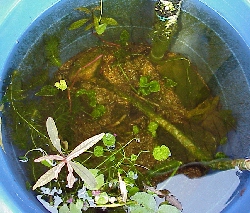
Green Water: This 18 gallon
mini pond has a u/g filter, a 301 powerhead, fairly fine gravel, and a large gourami in it. There were 2 gouramis
but a dog jumped in and stepped on one. (A partial water change was done after the dog was removed.) It has been
in full Texas sun since May 24th. This is a July 18th, 2000 photo. There is algae on the side, but you can see
the gravel. No carbon, no clarifiers, no chemicals at all have been used. There is no algae eater, no water changes
have been done. Some small pond plants are in it, mainly for shade for the gourami. Good fine filtration prevents
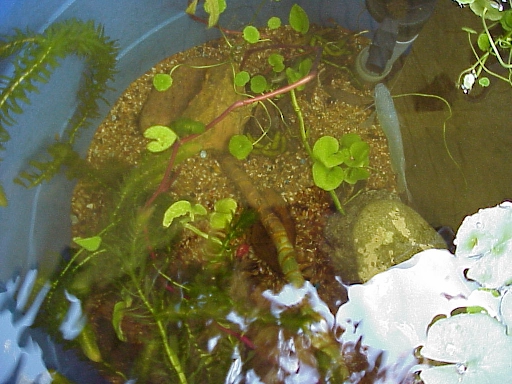
green water. An August 11th photo, after adding the pleco and 2 new gouramis, is shown below. Still no water changes,
no chemicals.
As of September 10, 2001, the water is still clear. A 6 inch Red Devil made his home in here for about a month,
so several water changes have been done, before he moved in, and after he left. Algae grows on the sides, but the
clarity remains immaculate.
January 2002 update. The mini-pond developed a very acidic pH and started getting water changes (and the occasional
dose of baking soda) in spring of 2001. Last week it was still clear, and it was obvious that the gravel was pretty
glutted with debris and fallen leaves, so the gravel got removed and rinsed in cold water, undergravel plate was
shaken off, the pond was reassembled. It still didn't have green water. Brown willow leaves don't look good though.
I'm down to one mosquito fish, probably due to the low pH, but lots of snails, and the plants were still alive.
Green algae feeds on nitrates and phosphates. Brown algae feeds on nitrites and nitrates. Red, black or dark green slime algaes are bacterial in origin, actually cyanobacteria. They feed on calcium carbonate, (lime), excess proteins and phosphates, and are most common in ponds and tanks with a high pH. Since plants will not thrive in an alkaline pond unless there is sufficient iron, magnesium and potassium present, the problem is compounded. Most ponds depend in part on live plants to filter and remove algae nutrients from the water.
High pH, excessive green algae, string algae and green water are often caused by limestone, concrete, mortar or cinderblock in contact with the pond water. We started making the connection in 2001. As of 2010 we have cleared a LOT of ponds by removing cinderblocks, sealing or removing limestone, concrete or mortar on the perimeter and in the water. We have located a quality sealant that does an excellent job on the stones or mortar that cannot be removed, leaving no visible evidence of its presence, except that water beads off the surfaces it is used on, and the water clears up.
So, what did you just read? A scientific experiment with a large fish in a small amount of water in full sun that did not turn green. does your pond turn green?
Fall 2006 update: The mini pond in full sun with perfect clarity isn't a rarity, but certain factors have made themselves very clear over the last 5 years.
Easy clear water without excessive algae growth in full sun depends on the absence of certain things. Those
things are algae nutrients that come from concrete and limestone in contact with the water. Even certain sandstones
can leach algae nutrient into pond water (or aquarium water).
Leach Test Instructions. Absolute testing of any stone for leaching requires
a few inexpensive items:
- about a gallon of RO water,
- an inert (plastic is good) container large enough to hold the stone covered with RO water, very well-rinsed
- a simple carbon dioxide generator which can be built with
- a 64 oz juice bottle, well-rinsed, containing dechlorinated tap or spring water
- airline tubing,
- plumbers putty or silicone to seal the drilled opening in bottle cap around tubing,
- a cup of sugar and 1/4 teaspoon of baking yeast,
- and a test kit that tests for GH and KH (general hardness and carbonate hardness).
Test strips that measure GH, KH and PH are needed. Be sure they are fresh and your container is clean. Test water in its container before putting in stone and airline, and record your results. if you have VERY hard water - high GH, high KH, you may have to buy a gallon of RO water or distilled water to perform the test. Set up the generator (juice bottle with water sugar and yeast, airline coming out of it, sealed in hole with plumbers putty) below the bowl or bucket containing the rock and RO, with the airline anchored under the stone but not compressed by it. Test again in 3 to 7 days. If a change occurs in 3 days, do not use it in your pond or aquarium. If no change occurs in 3 days, let the system continue to run for 7 days and retest. If GH and KH are the same as they were initially, the stone doesn't leach. If either one goes up, the stone leaches and will contribute to algae growth. How rapidly it goes up, and how high, will reflect how much of an algae problem it will cause. Faster and higher is much worse, but I haven't established a precise scale.
Green water or string algae are often fed by leaching limestone, concrete or cinderblock.
Cure for the
green water and string algae: X3. If the material you hae that is leaching is beautiful and important to the feature,
X3 Concrete Sealant, available on the Sealant page, is an excellent choice.
Requires draining the pond, powerwashing the stone, and of course the fish have to be elsewhere for a day or two
during sealing IF what you are sealing is below water level.
If you are sealing waterfalls fountains and can refill and use an air pump on the pond without contacting sealed surfaces, drain it, seal it, clean up drips, carefully refill pond to below sealed areas, put in chlorine remover fish, and use an air stone to aerate them. Allow sealed areas 24 hour cure time at 70 degrees, longer at lower temperatures, before water touches them.
This relatively* non-toxic aqueous silicone solution penetrates the stone, blot up all excess product
after first coat. 2nd coat needs applied 2 hours later, followed by blotting of excess and a 24 hour dry cure time.
The second coat will bond with the penetrating first coat, and form an impenetrable clear seal, no gloss, no
discoloration of your stone or mortar. UV resistant for about 2 years, then will require a re-coat, followed by
blotting of excess and a 24 hour dry cure time. We've tested this product on several ponds with limestone, mortar,
concrete and have had beautiful results easily verified with a simple pond test kit. Test pH and alkalinity in
your pond and water supply to know if this is your problem - both will be sky high on the pond, but not on the
water source if stonework, mortar or cinderblock is leaching. After sealant, both will be around the same level
as your water source. If a sample of your stone fails the leach test detailed above, Everything Fishy's Ultimate Stone
Sealant may be the answer to your algae problems, giving you the beautiful pond you've always dreamed of.
In the course of working on ponds in rural areas with a lot of minerals in the local well-water or city water supply, different algae symptoms have become obvious. One -- sometimes live plants just wither and die. Excess gypsum may produce a lot of algae, but will test very alkaline, with a pH as high as 9, but no GH (calcium / magnesium) on test strips. Complex plants such as lilies and bog plants require calcium magnesium, phosphorus and trace nutrients including iron. If the plants are healthy, and have sufficient trace elements, small amounts of lime in the water supply will be used up in time, thus growing less algae. We're still testing a couple of problem ponds to determine just what is missing. When we see a 'magical' turnaround in plant growth and a balance of algae, we'll have a formula of future benefits to our rural Texas customers. I suspect there are other areas of the world with similar problems.
Green water is the most frequent complaint I hear from owners of
relatively new aquariums with power or canister filters. Green water is caused by suspended algae. The algae feeds
on excess fish food and thrives on poor filtration due to plugged lines or filters that are too small for the tank.
But even when the filter is operating properly, sunlight and a couple of days overfeeding, or poor biological filtration
due to a cartridge change, or inadequate fine filtration media in your canister, can still cause your water to
look like pea soup, with your fish nearly invisible through the haze.
The cure is fairly simple. Remedy filtration problems. Check all pumps for blockages, worn out impellers, tired
air stones, anything that might cause inadequate water flow. Then:
- You may not want to put the power filter cartridge in the trash, especially if you've done a large water change recently, but do rinse it in cool, dechlorinated water. Then, add a fresh bag or pouch of high quality carbon to your filter. One treatment generally removes all the algae and spores, but the EF kit is a 2-pack, just in case.
- If you have a canister filter with large ceramic media, add floss or a sponge to one tray, high quality carbon to another.
- Undergravel filtered tanks occasionally suffer from green water, usually due to poor flow, (check pumps), too coarse gravel (add finer gravel to fill in some of the spaces), or over-vacuuming the gravel, especially on new tanks. Add a bag of carbon buried in your gravel, spread out as widely as possible, and in the future vacuum only 1/4 of the tank's surface once a month, at least until your aquarium is a year old.
- Occasionally the local tap water supply is responsible for green water. We service one aquarium that defied all of the above measures. But I removed the fish, external filter and part of the green water to an aquarium at our location, and topped off with dechlorinated Fort Worth water. The tank cleared in about 2 days. Cleaned everything thoroughly, tank, gravel, etc., returned it to its former location, topped off with their tap, and it went green again. I now carry in Fort Worth water to service their tank. Spores in their water supply must be responsible for the problem. As long as I don't add much of their water, the tank is clear.
All tanks (except the tiniest fry) should be fed no more than once a day, no more than the fish will eat in 5 minutes, or the green may return.
New Filter cartridges may also help clear green water, but do not combine a new filter cartridge with a large water change if your external is your only filter, or the situation may get worse instead of better.
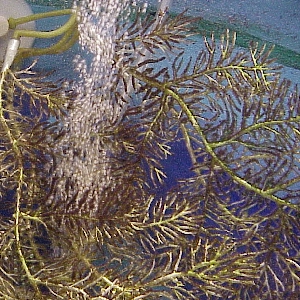 This white plant is covered with a brushy
film of red brush algae. It's in the 40 gallon described below, with high phosphate levels. This is the regrowth,
about 40 days after an occupied scrub down of the tank surfaces and powerheads, replacement of all plastic plants,
bleaching of rocks followed by a long soak in dechlorinator., and a series of 50% water changes. Short of removing
all of the fish and bleaching the tank, gravel, seals and pumps, no other cleaning could be done. Obviously it
wasn't enough. Phosphate sponge slowed it down substantially. While the silicone or pumps must be seeding the tank
with the red brush, it is taking 4 to 6 months to get this bad again. I allowed the problem to continue for a couple
of years after it first appeared, establishing a good seeding (actually spore) base in the aquarium. If I had dealt
with it more quickly, I might have already won the war.
This white plant is covered with a brushy
film of red brush algae. It's in the 40 gallon described below, with high phosphate levels. This is the regrowth,
about 40 days after an occupied scrub down of the tank surfaces and powerheads, replacement of all plastic plants,
bleaching of rocks followed by a long soak in dechlorinator., and a series of 50% water changes. Short of removing
all of the fish and bleaching the tank, gravel, seals and pumps, no other cleaning could be done. Obviously it
wasn't enough. Phosphate sponge slowed it down substantially. While the silicone or pumps must be seeding the tank
with the red brush, it is taking 4 to 6 months to get this bad again. I allowed the problem to continue for a couple
of years after it first appeared, establishing a good seeding (actually spore) base in the aquarium. If I had dealt
with it more quickly, I might have already won the war.
>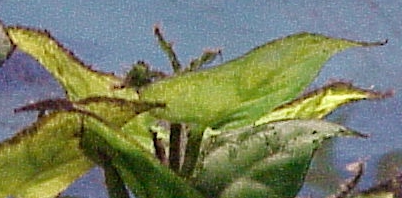 This closeup shows the plants' development
more clearly.
This closeup shows the plants' development
more clearly.
Older aquariums have different problems. Phosphates from tap water, fish food and fish wastes
can accumulate in the tank, feeding nuisances like red brush algae, and cyanobacteria. My 5 year old 40 gallon
tank had a phosphate level of over 5 ppm despite repeated large water changes in attempts to flush the tank.
Most Phosphate removers are aluminum based, and not very safe to use. Avoid breathing the dust all the same: aluminum is not good for humans, it has been known to contribute to alzheimers disease. We no longer sell it. If you do buy some, rinse with RO or clean tap water, immediately before use. Do not breathe the dust. It gets very hot when being rinsed.
Use rubber gloves, and lay the bag down in the sink as you pour water over it.
Iron based phosphate removers are safer but require percolating water slowly through them. The best cure for phosphate?
Do not overfeed your fish, do regular water changes. Occasionally tap water contains phosphate, when it does the
pH is usually low. Simply bumping the pH upward with a tiny amount of baking soda has been known to reduce
phosphate test results. (Tiny = 1/4 teaspoon per 10 gallons)
Monthly maintenance on your freshwater tank, or bi-weekly maintenance on your marine tank, will help to keep it, and your fish, healthy and attractive. We accept special orders for supplies and equipment.
© 1999 - 2018 by Alice Burkhart.